Who this module is for
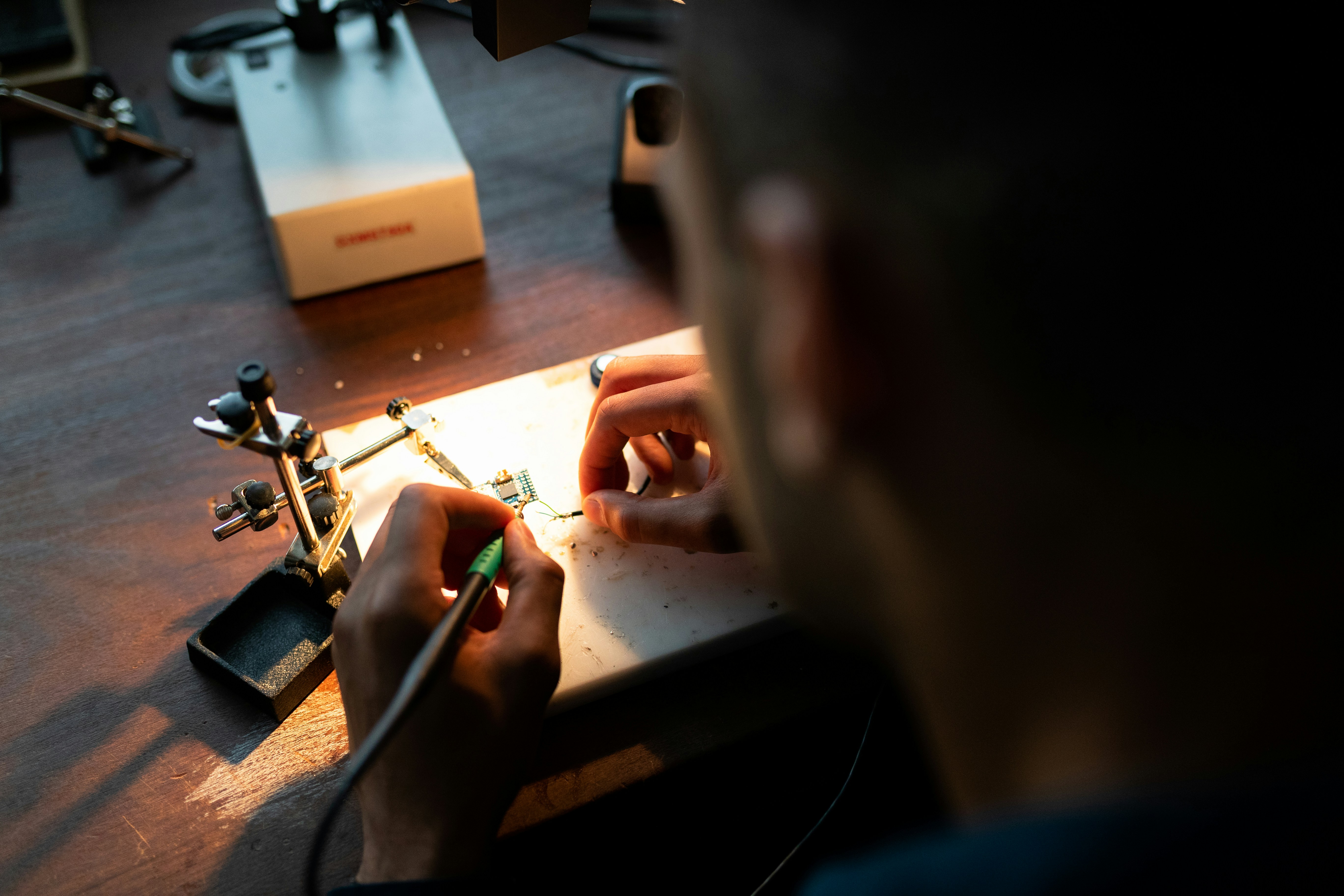
Any campus user who wants to use a MakerSpace soldering iron, hot air station or soldering hot plate.
This topic may be covered in some classes, but it remains available here so that you can get informed and trained at any time, directly with the MakerSpace manager.
Why this level of vigilance
The classic risks of a soldering station (burns, fumes) are moderate but real. Some risks do not show up straight away but build up with repeated exposure: this is the case, for example, of exposure to lead if leaded alloys are used. Feeling nothing at the time does not mean there is no long-term consequence: the instructions apply even when nothing seems to be happening.
Identified risks
Burns: iron and hot air station
Moderate risk
The soldering iron heats to between 350 and 450 °C, and the hot air station blows air at high temperatures. Never put the iron down anywhere other than on its insulated stand.
Burns: soldering hot plate
Moderate risk
Its surface reaches up to 400 °C and does not visibly change as it heats, unlike the tip of an iron: nothing tells the eye that it is scorching. Never put your hand on it, handle boards only with tweezers or a tool, and check that it is switched off and cooled down before leaving it unattended.
Flux and solder fumes
Moderate risk
Inhaling these fumes is irritating, even for a short job. Fume extraction is mandatory every time, whatever the duration.
Exposure to lead, fluxes and unknown residues (cumulative risk)
Moderate risk
The risk is not limited to lead: soldering fluxes, and the residues already present on a board (during a repair, for example), can also be irritating or toxic, even if the products you use yourself are considered safe. You can never be sure of what was used previously on a board under repair. It is a long-term risk: the effects are not immediate but get worse with repeated exposure over time. Wash your hands after use, and never eat or drink at the soldering station.
PPE and equipment required
Safety glasses
Extraction / ventilation mandatory
The glasses protect above all when trimming component leads after soldering: the cutters can send the snipped end of wire flying at some speed. They also limit the risk of splashes of flux or molten solder.
Fume extraction/ventilation is not PPE strictly speaking: it is a collective protection, to be switched on every time, even for a short job, and particularly during a repair where the composition of the solder or flux already in place may be unknown.
Tweezers or a dedicated tool are needed to handle boards on the hot plate, never bare hands.
Instructions before / during use
Always put the iron back on its insulated stand, never anywhere else.
Work under extraction, every time, even for a short job.
Always switch off the equipment (iron, hot air station, hot plate) once the work is done: it heats up quickly when powered on, so there is no point leaving it on for the next user.
Do not eat or drink at the station.
Never touch the surface of the hot plate with bare hands.
Do not keep liquids (isopropyl alcohol, flux cleaner…) in the immediate vicinity of the iron, the hot air station or the hot plate.
What to do in case of an incident
Whatever the incident, immediately tell the MakerSpace supervisor present: they take charge of the situation. Your safety comes first: if in doubt about an action, do not do it; raise the alarm and evacuate rather than intervene.
Burn: cool immediately under lukewarm water for several minutes. Let the victim adjust the water temperature themselves to whatever relieves them: neither icy nor hot.
Splash in the eye (flux, solder): rinse thoroughly with clean water for at least 15 minutes; always seek medical advice.